

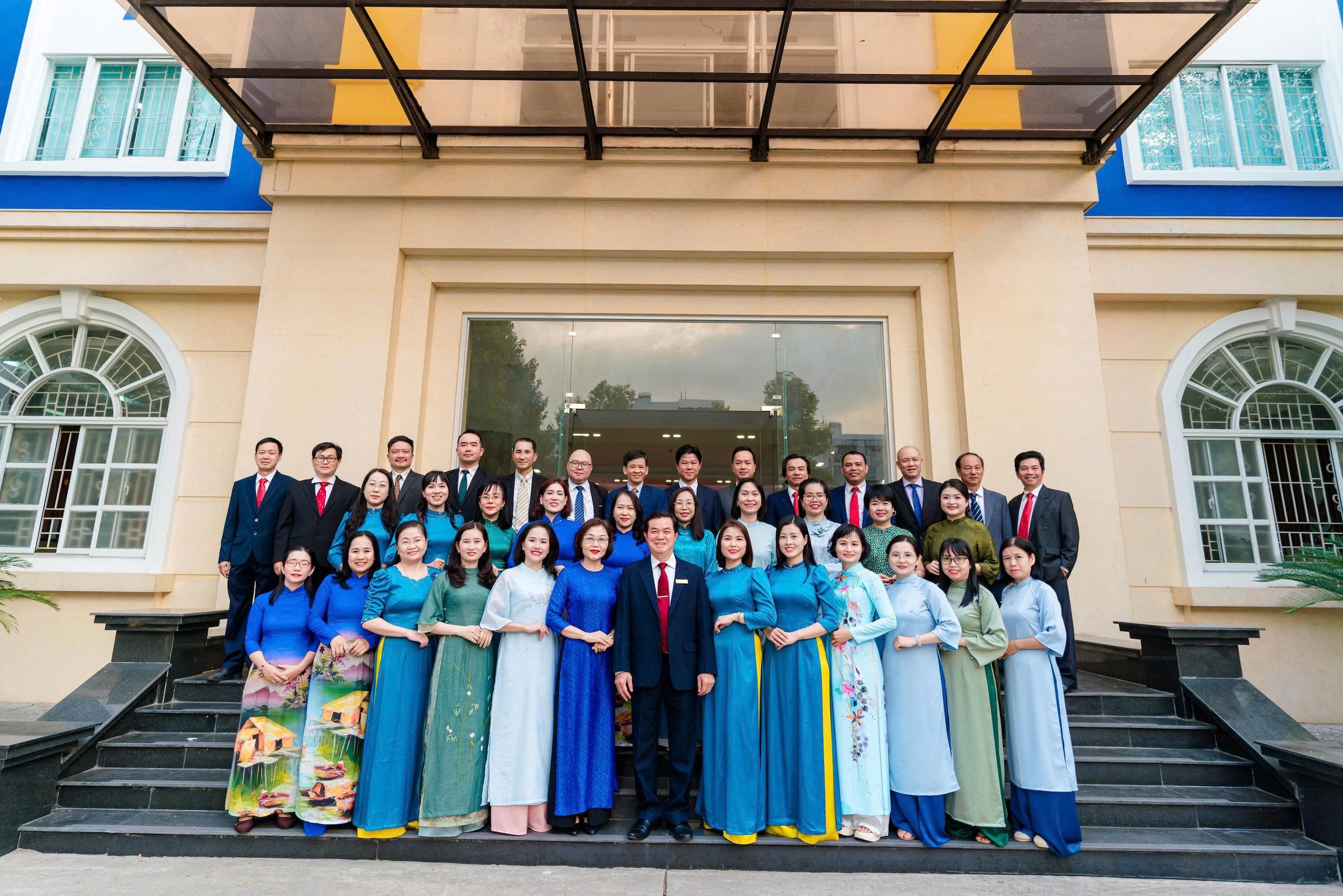
Introduction to the Faculty of Commerce And Tourism – 2026
1. Establishment and Development
The predecessor of the Faculty of Commerce and Tourism was the Faculty of Commerce, established on October 10, 2002. On May 27, 2004, it was renamed the Faculty of Commerce and Tourism following the upgrade of the Marketing Semi-Public College to the Marketing Semi-Public University under Decision No. 29/2004/QD-TTg dated March 5, 2004, issued by the Prime Minister.
On October 13, 2010, in response to the need to expand the scale of operations and enhance educational quality, the Faculty of Commerce and Tourism was divided into two separate faculties: the Faculty of Commerce and the Faculty of Tourism.
In August 2017, the Faculty of Commerce incorporated the Faculty of International Business from the College of Finance and Customs following the merger of the College of Finance and Customs into the University of Finance – Marketing under Decision No. 1138/QD-TTg dated August 4, 2017, issued by the Prime Minister.
On December 23, 2024, in implementation of Resolution No. 18-NQ/TW dated October 25, 2017, of the Central Committee on “Several Issues Concerning Continued Reform and Restructuring of the Political System toward a Streamlined, Effective and Efficient Organizational Structure,” and Directive No. 03/CT-BTC dated December 3, 2024, on the restructuring of the Ministry of Finance, the Faculty of Commerce and the Faculty of Tourism were merged to form the Faculty of Commerce and Tourism pursuant to Resolution No. 154/NQ-DHTCM-HDT dated December 23, 2024, issued by the University Council.
2. Mission, Vision, and Core Values
Mission
The Faculty of Commerce and Tourism is committed to developing human resources in International Business and tourism-related disciplines, including Tourism and Travel Services Management, Hotel Management, and Restaurant and Food Service Management, in accordance with national and regional standards. Its programs are designed to meet societal needs in the context of international integration and the Fourth Industrial Revolution.
The Faculty also conducts research and transfers scientific achievements related to human resource development, business management, strategic planning, and policy formulation for the development of international business and tourism activities serving enterprises and social organizations.
Vision
By 2035, the Faculty of Commerce and Tourism aims to become one of the leading institutions in Southern Vietnam for undergraduate and postgraduate education in International Business and tourism-related disciplines, including Tourism and Travel Services Management, Hotel Management, and Restaurant and Food Service Management. It also aims to become a recognized center for consultancy and knowledge transfer in human resource development, international business management, and tourism.
By 2045, the Faculty aspires to become a nationally and internationally accredited provider of undergraduate and postgraduate education and to rank among the leading academic units in Southern Vietnam.
Core Values
- To build a creative educational, scientific, and technological environment that promotes the value of knowledge in developing graduates who possess both strong professional competencies and a sense of civic responsibility.
- To encourage creativity and innovation and foster the passion of generations of lecturers, staff, and students by creating an environment of academic autonomy and stimulating enthusiasm for learning and scientific research.
- To respect differences within diversity and creativity while promoting collaboration among lecturers, staff, and students, as well as between the Faculty, its Departments, and individuals and organizations both within and outside the University.
- To regard quality, effectiveness, and sustainability as both guiding principles and objectives across all activities of the Faculty of Commerce and Tourism, aligned with the overall development of the University.
- To continuously learn from and integrate with global standards in order to develop tourism professionals with an international outlook who are prepared to participate in the ASEAN and global labor markets.
3. Academic Staff and Organizational Structure
Academic Staff
As of September 1, 2026, the Faculty of Commerce and Tourism has a total of 53 full-time lecturers and staff, including 4 Associate Professors with doctoral degrees, 25 lecturers holding doctoral degrees, 23 lecturers holding master’s degrees, and 1 Faculty Secretary.
All lecturers possess strong professional qualifications and pedagogical competencies. Many have completed master’s or doctoral studies in developed countries. Approximately 45% of lecturers are qualified to teach specialized courses in English, while 40% have several years of professional industry experience.
In addition, the Faculty collaborates in teaching, scientific research, and career consultancy with Professors, Associate Professors, and PhD holders from leading universities in Ho Chi Minh City, as well as senior managers from enterprises operating in international business and logistics.
Organizational Structure
The organizational structure of the Faculty of Commerce and Tourism includes:
- Faculty Council;
- Dean and Vice Dean;
- Academic Departments;
- Affiliated organizations, including the Faculty Trade Union, Faculty Youth Union and Student Association, Student Clubs, and the Faculty Alumni Liaison Committee.
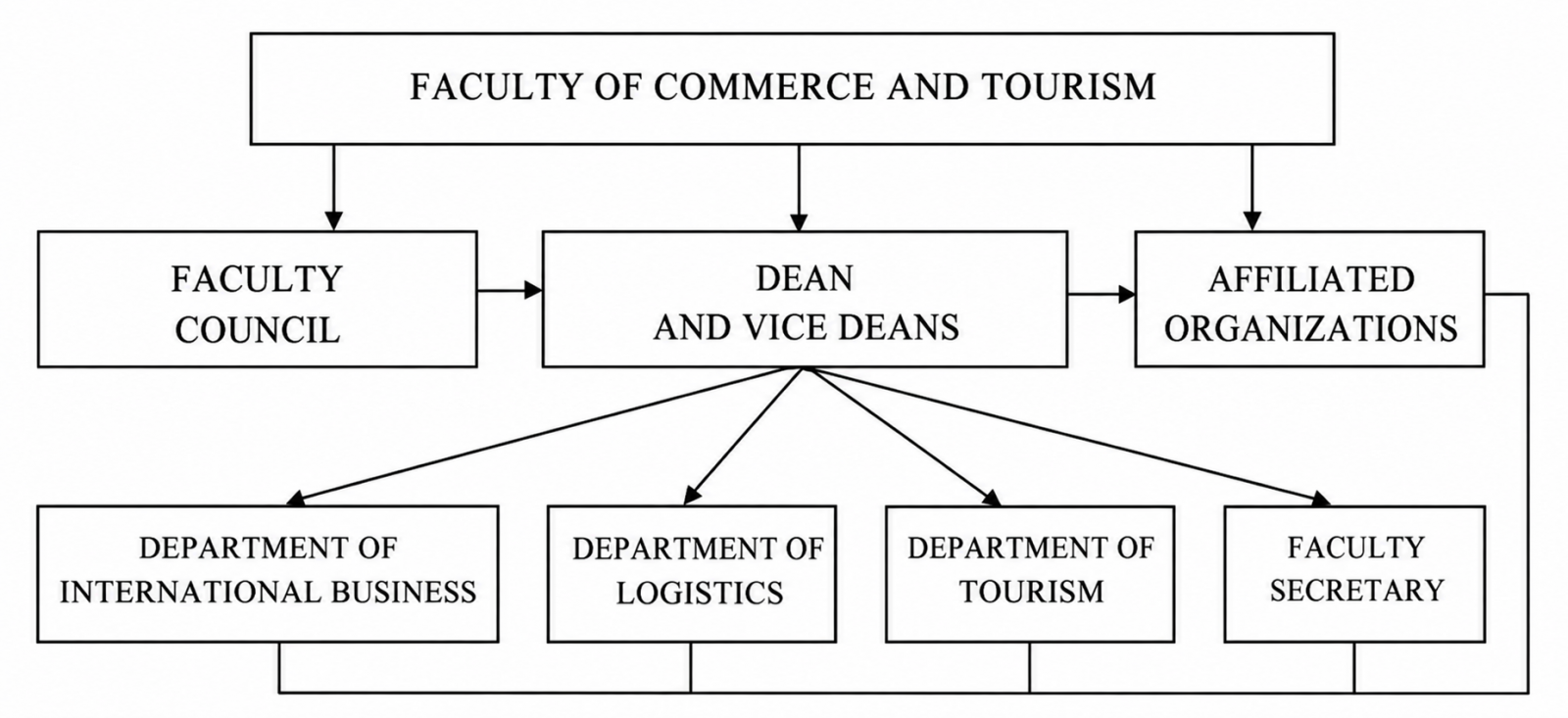
Organizational Structure of the Faculty of Commerce and Tourism
4. Academic Programs and Training Scale
Currently, the Faculty of Commerce and Tourism is responsible for managing and delivering four academic disciplines:
- International Business;
- Tourism and Travel Services Management;
- Hotel Management;
- Restaurant and Food Service Management.
For Tourism and Travel Services Management, Hotel Management, and Restaurant and Food Service Management, each discipline includes one specialization, with a combined annual intake of approximately 300–400 students.
These tourism-related programs are delivered under the specialized training mechanism of the Ministry of Education and Training pursuant to Official Letter No. 4929/BGDDT-GDDH dated October 20, 2017, on the application of specialized training mechanisms for tourism-related disciplines.
International Business
At the undergraduate level, the Faculty offers three specializations within International Business:
International Trade
International Business Management
Logistics and Global Supply Chain Management
The annual intake ranges from approximately 1,200 to 1,500 students.
Students acquire:
- In-depth knowledge and professional competencies in International Trade, International Business Management, and Logistics and Supply Chain Management, including international market research; import-export business planning; negotiation and conclusion of import-export contracts; organization, management, and execution of import-export contracts; logistics management; supply chain management for import-export goods and services; international investment; international business strategy; warehouse management; multimodal transportation management; freight forwarding and customs procedures; and port operations and management. These competencies enable students to adapt confidently to change and succeed in internationally integrated business environments.
- Professional working skills and competencies in managing and operating business activities in general, with particular emphasis on international business, logistics, and supply chain management within enterprises.
- The capacity for independent learning, research, and innovation in international business, logistics, and supply chain management, thereby fostering professional passion, career development, and continued study and research at higher academic levels.
High-Quality and Integrated Programs
Since 2013, in response to the labor market’s demand for high-quality human resources, the Faculty, in addition to the Standard Program (known as the general program prior to 2022), introduced the High-Quality Program in accordance with University policy.
A distinctive feature of this program was that its curriculum was developed based on surveys of labor market demand and the professional competency requirements associated with graduate employment positions. The curriculum was also benchmarked against programs offered by leading universities in Vietnam and advanced higher education institutions abroad.
The program required six credits more than the Standard Program, in accordance with regulations of the Ministry of Education and Training. Five core courses were taught in English. Teaching staff included highly qualified and experienced academics as well as professionals with extensive industry experience in fields relevant to the academic program. The curriculum was further enriched by extracurricular seminars delivered by senior managers from relevant industries.
Class sizes were limited to no more than 40 students, allowing lecturers to apply active teaching methods more effectively. Students were provided with comprehensive learning materials and received academic advising to develop study plans suited to their individual abilities and learning conditions.
Throughout the program, the University cooperated with enterprises each year and each semester to organize company visits and experiential internships. As a result, graduates were equipped not only with theoretical knowledge but also with in-depth practical professional knowledge, occupational skills, soft skills, initiative, creativity, and a positive and responsible attitude toward their chosen profession.
Building upon these achievements and in accordance with the 2012 Law on Higher Education, as amended in 2018, the High-Quality Program in International Business was transformed into the Integrated Program beginning in the 2023 academic year.
Compared with the former High-Quality Program, the Integrated Program emphasizes:
Integration of theory and practice, with a strong focus on experiential education;
Integration of traditional and modern teaching methods and educational technologies;systematic application of active teaching and learning methods;
Enhancement of students’ independent learning and research capabilities;
Interdisciplinary integration between the principal discipline and supporting fields;
Stronger foreign-language competencies;
Opportunities to obtain professional qualifications, particularly international certificates;
Opportunities to complete selected master’s-level courses in advance; and
Opportunities to pursue a double-major pathway and obtain two degrees upon successful completion.
Advanced Program in English
Also beginning in the 2023 academic year, in response to the growing demand for high-quality human resources with strong foreign-language proficiency and international integration capabilities, the Faculty introduced the Advanced Program in English in International Business, alongside the Integrated Program.
Compared with the former High-Quality Program, this program is closely aligned with curricula offered by advanced higher education institutions abroad. All courses are delivered in English, except those belonging to Marxist-Leninist studies.
The program also provides international student exchange opportunities with partner higher education institutions in developed countries.
In addition to developing interdisciplinary professional competencies, the program enables students to strengthen their English proficiency and international integration capabilities before graduation. This helps graduates meet the increasingly demanding requirements of the labor market both today and in the coming decades.
Tourism-Related Programs
Since 2018, the Faculty of Commerce and Tourism has delivered three tourism-related disciplines under the specialized training mechanism of the Ministry of Education and Training pursuant to Official Letter No. 4929/BGDDT-GDDH dated October 20, 2017:
- Tourism and Travel Services Management;
- Hotel Management;
- Restaurant and Food Service Management.
Hotel Management
Students in the Hotel Management program are equipped with:
- In-depth knowledge and professional skills in organizing, supervising, and operating front office, housekeeping, and food and beverage departments; managing human resources and finances in hotel businesses; marketing, sales, and customer care; organizing events and conferences; revenue management; brand development strategy; and internationally standardized hotel service quality management. These competencies enable students to adapt confidently to change and succeed in multicultural and globally integrated accommodation service environments.
- Professional working skills, communication skills, flexible problem-solving abilities, and management and operational competencies applicable to business activities in general and to hotels and luxury resorts in particular.
- The capacity for independent learning, research, and innovation in hotel management, supporting professional development and further study and research at higher academic levels.
Restaurant and Food Service Management
Within Restaurant and Food Service Management, the Faculty offers the Restaurant Management specialization with the objective of equipping students with:
- In-depth knowledge and professional skills in organizing, supervising, and operating restaurants, coffee chains, and bars; food and beverage service management and menu planning; food and beverage cost control; food hygiene and safety management; human resource and financial management in food service businesses; marketing, sales, and customer care; banquet, conference, and culinary event organization; brand development strategy; and food service quality management. These competencies enable students to adapt effectively to change and succeed in globally integrated food service environments.
- Professional working skills, communication skills, flexible problem-solving abilities, and management and operational competencies relevant to restaurant and food service enterprises.
- The capacity for independent learning, research, and innovation in Restaurant and Food Service Management, thereby fostering professional passion and supporting continued study and research at higher academic levels.
Tourism and Travel Services Management
Within Tourism and Travel Services Management, the Faculty offers the Travel Management specialization at the undergraduate level, with the objective of equipping students with:
- Advanced knowledge and skills in domestic and international tour guiding; tour design and operations; tourism event organization; tourism routes, destinations, heritage, and resources; tourism and destination marketing; sales and customer care; travel business management; destination management; strategic management; human resource management; MICE tourism; and tourism risk management. In addition, the program provides a broad foundation in business and management, enabling students to adapt to diverse professional environments.
- Professional working skills in communication, customer service, teamwork, problem-solving, and the management and operation of tourism and travel enterprises, service establishments, and destination management organizations.
- The capacity for independent learning, research, innovation, and creativity in tourism, supporting lifelong learning and continued study and research at higher academic levels.
5. Development Orientation
The Faculty aims to further enhance the application-oriented education model across all academic programs while accelerating digital transformation and the application of artificial intelligence in response to the Fourth Industrial Revolution. These efforts are aligned with the University’s educational philosophy and core values and are directed toward modernization, improved educational quality, and international integration.
- Maintain the Faculty’s training scale at approximately 4,000–5,000 students and postgraduate learners. From 2026, standardize undergraduate delivery of the Integrated Program in International Business and specialized training for tourism-related disciplines; expand both the scale and quality of the Master’s Program in International Business; introduce master’s programs in tourism-related disciplines from 2028; and launch a doctoral program in International Business from 2030.
- Enhance the scientific research and technology transfer capacity of lecturers and students. Beginning in 2026, all lecturers are expected to produce scientific research or technology transfer outputs published in scientific journals with ISSN registration each year. In 2026, approximately 35–45% of lecturers are expected to publish articles in reputable international journals, increasing to 60–65% by 2030. The Faculty will continue improving research quality, diversifying research activities, prioritizing research with strong potential for transfer and practical application to the country’s socio-economic development, strengthening international cooperation in research and technology transfer, and diversifying and improving the quality and effectiveness of community engagement activities.
- Develop the Faculty’s academic workforce to approximately 55–60 lecturers by 2030. Of these, 70–80% are expected to hold doctoral degrees or Associate Professor titles, 50–60% are expected to be qualified to teach courses in English, and more than 70% are expected to possess the competencies required to teach theoretical courses and supervise practical training under an application-oriented education model.
- Strongly expand educational cooperation with educational institutions and enterprises to share infrastructure and resources and enhance the effectiveness of application-oriented training. By 2030, the Faculty of Commerce and Tourism aims to establish formal training partnerships with at least 50 enterprises and two reputable international educational institutions.
For the Faculty of Commerce and Tourism
Dean
Dr. Nguyen Xuan Hiep